

By: AI Industry Analysis Desk
In the rapidly expanding universe of artificial intelligence, a silent crisis is brewing. While the industry is flooded with researchers and data scientists focused on the "art" of model training—tweaking hyperparameters and architecting neural networks—there is a critical, often neglected discipline required to turn these laboratory experiments into real-world utility: Machine Learning (ML) Systems Engineering.
As Jason Jabbour, Kai Kleinbard, and Professor Vijay Janapa Reddi of Harvard University aptly summarize, "Everyone wants to do the modeling work, but no one wants to do the engineering." This sentiment underscores a growing realization that the future of AI does not belong solely to those who build the most accurate models, but to those who can build the most robust, efficient, and scalable engines to deploy them.

The Architecture of the Problem: Main Facts
At the heart of the current AI bottleneck is the disconnect between theoretical performance and physical reality. An LLM (Large Language Model) that performs brilliantly in a controlled environment often collapses when faced with the latency, throughput, and hardware constraints of a production system.
The "Astronaut vs. Rocket Scientist" analogy used by the Harvard team is increasingly relevant. If the ML developer is the astronaut dreaming of distant galaxies, the ML systems engineer is the aerospace engineer ensuring the rocket actually leaves the launchpad. Without the underlying infrastructure—optimized memory access, hardware-aware quantization, and distributed training pipelines—the most sophisticated neural networks remain trapped in static, unusable states.
The challenge is exacerbated by a vacuum in educational resources. While textbooks on deep learning theory are abundant, pedagogical material on the "plumbing" of AI—such as how to map an algorithm to specific TPU architectures or how to manage memory at scale—remains scarce.

From Classroom to Global Initiative: A Chronology
The movement to formalize ML Systems Engineering began within the halls of Harvard University. It originated as a specialized response to the needs of students in the CS249r "Tiny Machine Learning" course.
- The Genesis (2023): Harvard launched its TinyML course, which forced students to grapple with the realities of running models on resource-constrained embedded devices. This provided the "Aha!" moment: the principles of efficiency are universal, whether applied to a tiny sensor or a massive server farm.
- Expansion to Open Source: Recognizing that these lessons were vital for the broader industry, the team transitioned the course materials into a living, open-source project: MLSysBook.ai.
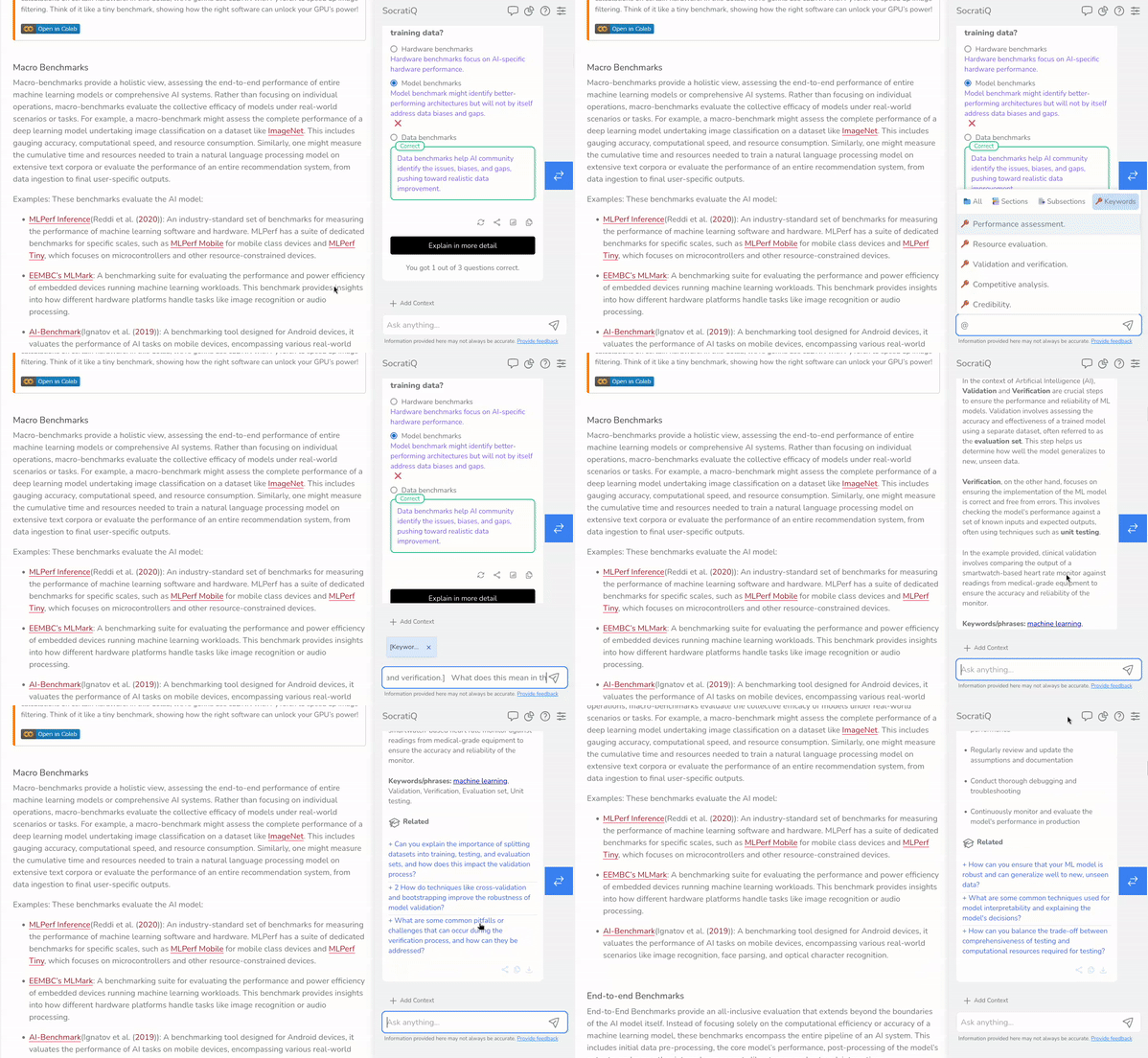
- Interactive Evolution: Most recently, the project integrated SocratiQ, an AI-powered learning assistant. This shift represents a transition from static textbook learning to a dynamic, co-creative educational experience where the learner engages in real-time, personalized dialogue with the curriculum.
- Integration with Industry Ecosystems: The project has now begun mapping its core principles to the TensorFlow ecosystem, providing a tangible bridge between high-level academic theory and the tools used daily by industry practitioners.
The Pillars of Efficiency: Supporting Data
To understand why ML Systems Engineering is becoming a prerequisite for AI success, one must look at the lifecycle of a modern model. Data engineering, model development, hardware optimization, deployment, and continuous maintenance form a cyclical chain.
- Quantization: A primary example of system-level thinking. By reducing the precision of model weights (e.g., from FP32 to INT8), engineers can shrink model sizes by four times with minimal accuracy loss, allowing sophisticated models to run on mobile devices or edge hardware.
- Hardware Mapping: As AI models grow, the bottleneck often shifts from compute to memory bandwidth. Understanding the memory hierarchy—from HBM (High Bandwidth Memory) to SRAM—is no longer optional for those aiming to achieve peak performance.
- The Deployment Loop: Research from the MLSysBook initiative suggests that the "model" is merely the starting point. Deployment involves managing inference pipelines, load balancing, and monitoring for "data drift," where the model’s accuracy degrades as the real-world data changes over time.
The data supports a clear conclusion: The cost of failing to optimize for systems is not just technical; it is financial. Inefficient models lead to ballooning cloud compute costs, increased energy consumption, and slower time-to-market.

The Human Element: Official Perspectives
The authors behind MLSysBook.ai emphasize that their work is not meant to replace traditional ML theory but to provide the missing half of the equation. According to the Harvard team, the goal of integrating tools like SocratiQ and mapping concepts to TensorFlow is to democratize the "black box" of systems engineering.
"We want to move the learner from passive consumption to active engagement," says the team. Their collaboration with industry leaders, including support from experts like Josh Gordon, signals an industry-wide push to standardize how we teach the intersection of software engineering and statistical modeling.
Furthermore, the initiative has taken a unique approach to funding. By leveraging GitHub Stars as a metric for success, they have secured sponsorships that translate directly into scholarships for students and underrepresented groups globally. This creates a virtuous cycle: the more the community engages with these systems-level resources, the more the next generation of engineers is empowered to push the boundaries of what is possible.

Implications for the Future of AI
The implications of this shift are profound for both individual careers and organizational strategy.
For the Practitioner
The career path of the future is not just "Data Scientist," but "Machine Learning Engineer." The ability to understand why a model is slow, how to profile it against specific GPU kernels, and how to orchestrate a distributed training job will become the most valuable skill set in the job market. Practitioners who ignore the "Systems" side of the equation will find their models increasingly relegated to prototypes that never see the light of day.
For the Organization
Companies that silo their "Modelers" from their "Infrastructure Engineers" will suffer from high friction and slow iteration cycles. Successful organizations are already moving toward cross-functional teams where ML systems knowledge is a core competency. This reduces technical debt and ensures that the transition from a research notebook to a production-grade API is seamless.

For the Industry
The rise of generative AI and LLMs has made systems engineering a bottleneck. With training runs costing millions of dollars and inference requiring massive GPU clusters, even a 10% gain in system efficiency translates into millions of dollars in savings and significant environmental impact. The focus is shifting from "Can we build it?" to "Can we run it efficiently at scale?"
Conclusion: The Path Forward
The gap between machine learning modeling and systems engineering is not merely an academic concern; it is a fundamental hurdle to the democratization and sustainability of artificial intelligence. As we look toward a future where AI is ubiquitous—embedded in everything from household appliances to global financial networks—the importance of the "rocket scientists" of the ML world cannot be overstated.
The efforts of the MLSysBook.ai team, supported by the broader TensorFlow community and innovative learning platforms like SocratiQ, represent a crucial maturation of the field. By treating system engineering as a first-class citizen in the ML curriculum, we ensure that the next generation of AI developers is equipped not just to dream, but to build.

As the adage goes, "Even the most brilliant astronauts need skilled engineers to build their rockets." The mission to Mars—or in this case, the mission to deploy world-changing AI—depends on it. For those looking to make a lasting impact, the call to action is clear: dive into the systems, bridge the gap, and start building the engines that will drive the next decade of innovation.
For those interested in exploring these concepts further, the MLSysBook.ai project invites community collaboration and offers a deep dive into the end-to-end lifecycle of production-ready machine learning.